

Experts Vote 7–2 in Favor of Bell-to-Bell Smartphone Bans in Schools
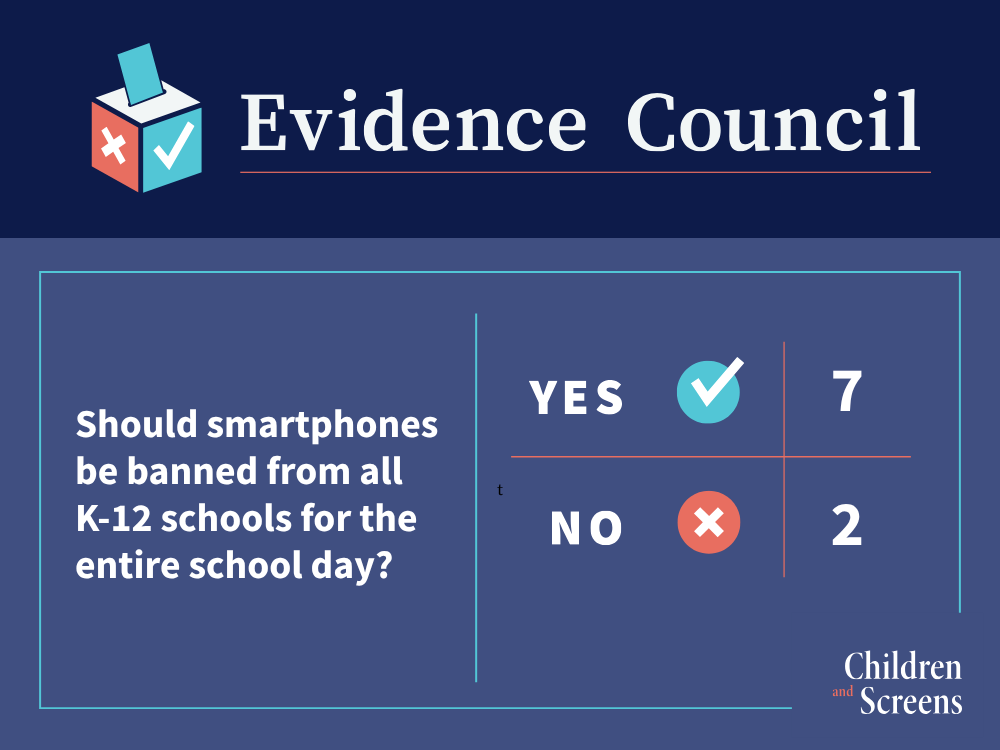
Children and Screens Evidence Council finds strong support for full-day restrictions, with calls for flexibility and further research.
NEW YORK, NY, UNITED STATES, April 14, 2026 /EINPresswire.com/ -- A strong majority of leading child development and mental health experts agree that smartphones should be restricted for the entire school day in K–12 schools, citing concerns about attention, learning, and social development.In its latest vote-based position, the Children and Screens Evidence Council voted 7–2 in favor of “bell-to-bell” smartphone bans - policies that limit student access to personal devices from the start to the end of the school day. Read the full report HERE.
The vote comes as school districts and state leaders across the country debate how to address the impact of smartphones on student focus, classroom environments, and mental health.
“Schools are where children learn how to think critically, focus their attention deeply, and connect with peers,” said Kris Perry, Executive Director of Children and Screens. “This vote reflects growing concern that access to smartphones during the school day can interfere with those core developmental tasks, while also recognizing that how these policies are implemented matters.”
Experts who voted in favor emphasized that smartphones can undermine attention and learning, even when not actively in use. Council members raised several key concerns:
• Reduced concentration and cognitive capacity: Research shows that even the presence of a phone - silent or in a backpack - can divert attention and reduce students’ ability to focus
• Displacement of learning and social interaction: Students may spend significant portions of the school day on their phones, taking time away from instruction and face-to-face engagement
• Impacts on classroom environment: Early evidence suggests that restricting phone access can improve academic performance, behavior, and overall classroom dynamics
• Mental health and well-being: Limiting exposure to social media during the school day may reduce stressors and allow more time for healthier activities and peer connection
“School time is precious,” said Dr. Dimitri Christakis, pediatrician and Council member. “Studies show that adolescents spend 25 percent of it on their phones. That time— whether it’s during class, recess or lunch —comes at the expense of learning or face to face interaction. Those experiences are essential to developing children’s learning and social skill acquisition.”
Other experts noted that removing smartphones from the school day may also create space for more meaningful peer interaction and reduce the pull of constant digital distraction.
“Smartphones are an irresistible distraction from schoolwork and the face to face connections,” said Dr. Paul Weigle, child and adolescent psychiatrist and Council member. “We don’t allow kids to smoke or drink alcohol and cannot expect them to manage smartphone use. Smartphone bans give youth the relief from distraction to allow for academic success, healthy relationships, and better mental health. Studies of bans have shown improvements on classroom environment, academic performance, behavior, and need for mental health support.”
"At the same time, Council members emphasized the need for continued research to evaluate the efficacy of one-size-fits-all approaches. Two members voted against a universal bell-to-bell ban, citing the need for more evidence and greater flexibility in how policies are designed.
Dissenting perspectives raised several considerations, including:
• The need for more robust research to determine when and for whom phone restrictions are most effective
• The importance of accounting for differences in age, school context, and community needs
• Ensuring appropriate exceptions for students who rely on phones for accessibility, safety, or specific learning needs
• The value of involving parents, students, and educators in shaping policies
“We do not yet have clear enough evidence to support a universal bell-to-bell smartphone ban in all K-12 schools,” said Dr. Desmond Patton, Council member. “Schools should partner with local universities, parent groups, and students to collect and evaluate data on when phones are harmful, for whom, and when they are useful, including for students with invisible disabilities or during emergencies.”
Even among those who supported restrictions, many emphasized that thoughtful implementation is critical. Council members pointed to the importance of developmentally appropriate policies, clear communication with families, and ongoing evaluation of outcomes.
While empirical research on school phone bans is still evolving, experts noted that current evidence points to potential benefits for student focus, learning, and overall well-being. They also stressed the need for continued study to better understand how different approaches affect diverse student populations over time.
The Evidence Council’s position does not advocate for specific laws or mandates. Instead, it provides an evidence-informed foundation to help parents, educators, journalists, and policymakers understand where expert consensus exists - and where important questions remain.
“Our goal is clarity, not oversimplification,” Perry added. “These are complex decisions, and families and schools deserve guidance that reflects both the evidence we have and the uncertainties that remain.”
More information about the Evidence Council is available at www.childrenandscreens.org.
About the Children and Screens Evidence Council
The Children and Screens Evidence Council is a new initiative composed of leading researchers and clinicians from the Institute’s National Scientific Advisory Board. The Council issues concise, vote-based evidence statements on major questions affecting children’s digital lives, offering transparent insight into expert agreement and disagreement. Each position includes the vote outcome, key scientific considerations, and individual expert rationales.
About Children and Screens
Children and Screens is an independent, non-profit organization dedicated to advancing and supporting research, informing policy, and educating the public about children’s digital media use and its impact on cognitive, psychological, social, behavioral, and physical development.
Jon Bleicher
Children and Screens
+1 973-330-1711
email us here
Visit us on social media:
LinkedIn
Instagram
Facebook
YouTube
X
Legal Disclaimer:
EIN Presswire provides this news content "as is" without warranty of any kind. We do not accept any responsibility or liability for the accuracy, content, images, videos, licenses, completeness, legality, or reliability of the information contained in this article. If you have any complaints or copyright issues related to this article, kindly contact the author above.
