

Construction, Hospitality, and Retail Among Sectors Facing Elevated Insolvency Risk in 2026

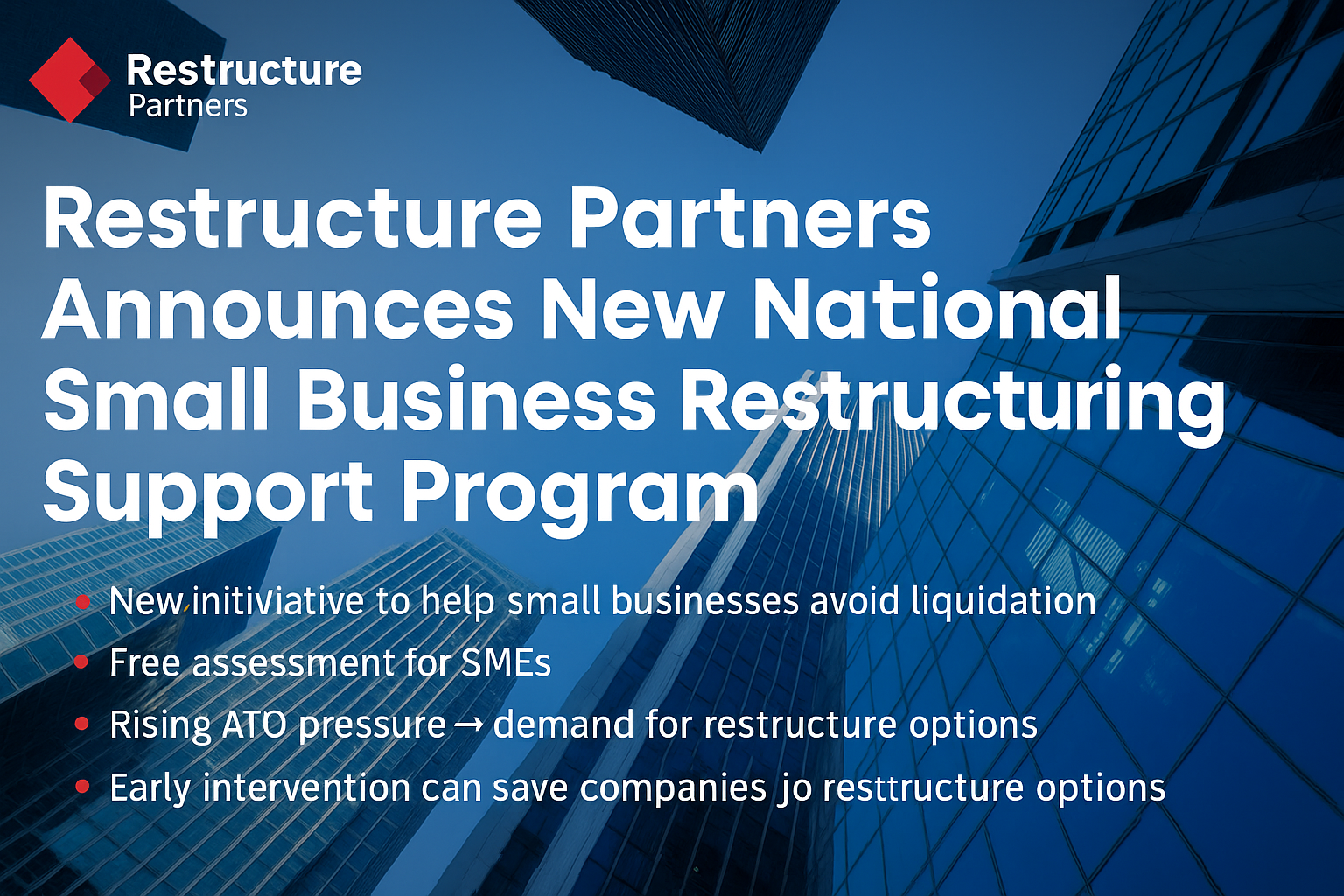
Restructure Partners
Three of Australia's largest employing sectors are navigating conditions that insolvency advisers describe as among the most challenging they have seen.
Three of Australia's largest employing sectors are navigating conditions that insolvency advisers describe as among the most challenging they have seen in recent memory.”
SYDNEY, NSW, AUSTRALIA, April 10, 2026 /EINPresswire.com/ -- Three of Australia's largest employing sectors are navigating conditions that insolvency advisers describe as among the most challenging they have seen in recent memory. Construction, hospitality, and retail collectively represent tens of thousands of small businesses — and in 2026, all three are facing financial pressures that have elevated insolvency risk across the board.— Restructure Partners
ReStructure Partners helps Australian directors navigate every stage of ATO and financial distress, from overdue BAS and tax debt through to Director Penalty Notices, restructuring solutions, voluntary administration, and broader insolvency options. The firm's advisory work across all three sectors provides a granular view of the pressures these businesses face and the options that may assist directors depending on the circumstances. Across each of these industries, the firm works with directors to assess their position and explore whether restructuring or other formal pathways may be appropriate.
Construction: A Sector Under Sustained Pressure
Australia's building and construction industry has been operating under conditions of significant financial stress for an extended period. The combination of fixed-price contract risk, post-pandemic cost inflation, labour supply constraints, and the cash flow risks of a project-based business model has not resolved itself — and the sector remains one of the highest contributors to national insolvency appointment numbers in 2026.
For directors of construction businesses, the ATO dimension is particularly acute. The industry's complex workforce arrangements — combining employees, subcontractors, and labour hire workers — have historically created PAYG withholding and superannuation compliance challenges. Directors who allowed these obligations to lapse during the pandemic period may face Director Penalty Notice exposure that cannot be resolved simply by placing the company into administration where the obligations were not reported on time.
Directors of construction businesses who have not yet reviewed their ATO compliance status and personal liability position should do so as a priority. Guidance on DPN exposure specific to construction directors is available at https://restructurepartners.com.au/director-penalty-notice.
Hospitality: Margin Pressure Without Relief
The hospitality sector's financial difficulties in 2026 stem from a fundamentally challenging intersection of rising costs and constrained revenue.
On the cost side, labour represents the dominant expense for most hospitality businesses, and successive award wage increases have driven wages costs up substantially. Food, beverages, energy, and rent have all increased materially from pre-pandemic levels, and in most cases, these increases have not been fully passed through to consumer prices.
On the revenue side, consumer discretionary spending on food and beverage has moderated as household budgets are stretched. The combination of higher costs and lower real revenue is producing a margin squeeze that is, for many operators, structurally unsustainable.
Many hospitality businesses also carry ATO debts from the pandemic period that were deferred and never fully resolved. These legacy obligations, combined with the current trading environment, are driving a growing number of operators toward formal insolvency processes.
Retail: Structural Disruption Compounds Cyclical Weakness
Australia's independent and small-chain retail sector is dealing with both a structural challenge — the ongoing migration of consumer spending to online channels — and a cyclical one, as household budget pressures reduce discretionary spending.
Retailers who locked in lease commitments during more buoyant trading periods are finding those obligations extremely difficult to exit, even where the trading performance of the store no longer supports the rent. ATO debt is prevalent in the retail sector, reflecting both the cash-intensive nature of many retail operations and the compliance challenges of the pandemic period.
What Directors in All Three Sectors Should Do Next
The common thread across construction, hospitality, and retail is the convergence of legacy ATO debt and current operational pressure. Directors in any of these sectors who are experiencing financial difficulty are encouraged to seek qualified advice about the restructuring and insolvency options that may be available.
Information on the small business restructuring process — which may assist eligible businesses in all three sectors — is available at https://restructurepartners.com.au/small-business-restructuring.
ReStructure Partners works with Australian directors and business owners experiencing financial pressure, including ATO debt, cash flow issues, and creditor stress. The firm provides support across the full spectrum of financial distress, from early-stage tax arrears and compliance issues through to Director Penalty Notices, small business restructuring, voluntary administration, and other insolvency pathways, depending on the circumstances.
Contact:
ReStructure Partners
https://restructurepartners.com.au
###
Restructure Partners
Restructure Partners
+61 468 061 936
email us here
Legal Disclaimer:
EIN Presswire provides this news content "as is" without warranty of any kind. We do not accept any responsibility or liability for the accuracy, content, images, videos, licenses, completeness, legality, or reliability of the information contained in this article. If you have any complaints or copyright issues related to this article, kindly contact the author above.
