

Antiperspirant and Deodorant Market to Reach USD 5.78 Billion by 2032, Expanding at 4.3% CAGR| Maximize Market Research
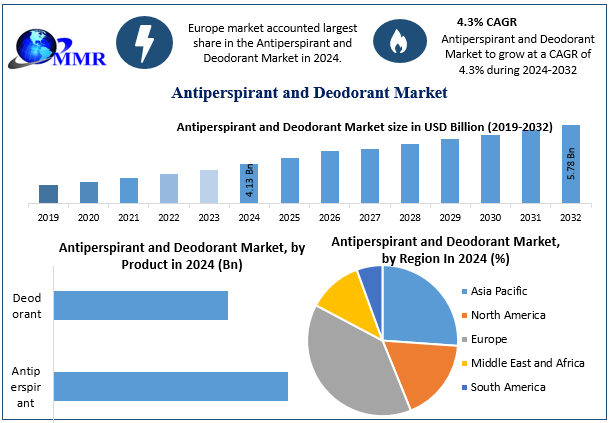
Antiperspirant and Deodorant Market graph
Antiperspirant and Deodorant Market was valued at USD 4.13 billion in 2024 and is projected to reach nearly USD 5.78 billion by 2032, growing at a CAGR of 4.3%
Rising demand for aluminum-free and natural deodorants is reshaping product innovation and brand positioning in the global market”
ROCKVILLE , MD, UNITED STATES, March 6, 2026 /EINPresswire.com/ -- Global Antiperspirant and Deodorant market size was valued at USD 4.13 Billion in 2024 and the total revenue is expected to grow at a CAGR of 4.3% from 2026 to 2032, reaching nearly USD 5.78 Billion by 2032.— Maximize Market Research
The Antiperspirant and Deodorant Market comprises a wide range of personal care formulations including aerosol sprays, roll-ons, sticks, gels, creams, and wipes designed to control body odor and reduce perspiration. These products integrate fragrance compounds, antimicrobial agents, and sweat-blocking ingredients such as aluminum salts that help maintain freshness and hygiene throughout the day. The market is gradually shifting from conventional odor-masking formulations toward dermatologically tested, skin-friendly, and natural ingredient-based solutions, where product safety, fragrance innovation, and brand positioning increasingly influence competitive dynamics across mass and premium segments.
Get Full PDF Sample Copy of Report: (Including Full TOC, List of Tables & Figures, Chart) @ https://www.maximizemarketresearch.com/request-sample/23771/
Antiperspirant and Deodorant Market Dynamics
Growth across the Antiperspirant and Deodorant Market is increasingly supported by rising awareness of personal hygiene and grooming habits. Consumers are showing strong preference for long-lasting, skin-friendly, and aluminum-free formulations. Manufacturers are responding through product innovation, including natural ingredients and dermatologically tested products. For example, brands under Unilever and Procter & Gamble have expanded their deodorant portfolios with aluminum-free and plant-based variants to attract health-conscious consumers. Additionally, the rapid growth of online retail platforms and beauty e-commerce has significantly improved product accessibility, strengthening market demand across regions such as North America and Asia-Pacific.
Concerns related to skin sensitivity and the use of chemical ingredients remain a structural restraint within the antiperspirant and deodorant market. Certain consumers associate aluminum salts and artificial fragrances with skin irritation or potential health risks, which has led to cautious purchasing behavior. For instance, in several European markets, demand has gradually shifted toward natural deodorant alternatives as consumers prefer clean-label products. Moreover, premium organic deodorants often cost significantly more than conventional products, which can limit adoption among price-sensitive consumers in emerging economies.
The global antiperspirant and deodorant market faces challenges from intense brand competition and evolving consumer expectations. Major multinational companies such as L'Oréal and Beiersdorf continue to invest in fragrance innovation, sustainable packaging, and dermatological testing to maintain market share. At the same time, cosmetic regulations differ across regions. For example, products sold in Europe must comply with safety standards set by the European Commission, which requires ingredient transparency and product safety assessments. These regulatory requirements can increase development costs and slow product launches in international markets.
Key Trend: Rapid Expansion of E-Commerce and Direct-to-Consumer Channels
A significant trend shaping the Antiperspirant and Deodorant Market is the rapid expansion of e-commerce and direct-to-consumer (DTC) sales channels. Consumers are increasingly purchasing personal care products through online platforms, enabling brands to introduce niche products, subscription models, and personalized fragrance offerings. Digital retail channels also allow companies to gather consumer preference data and accelerate product launches. For example, companies such as Unilever and Procter & Gamble are strengthening their digital distribution strategies and partnering with online marketplaces to expand their reach, illustrating how e-commerce integration is reshaping distribution dynamics and competitive strategies in the global deodorant market.
Strategic Opportunity Analysis
A significant opportunity in the Antiperspirant and Deodorant Market lies in the development of refillable and sustainable packaging solutions. As environmental awareness grows, consumers are increasingly favoring eco-friendly personal care products. Brands introducing refill packs, recyclable containers, and reduced-plastic packaging can strengthen customer loyalty while lowering long-term packaging costs, creating new competitive advantages in the global deodorant industry.
Regional Analysis – Global Antiperspirant and Deodorant Industry
As of early 2026, the global antiperspirant and deodorant landscape is characterized by a high degree of regional maturity in Western markets and aggressive, volume-driven growth in emerging economies. Europe currently holds the position as the global market leader, commanding a share of approximately 34% to 35%. This leadership is underpinned by a sophisticated personal care infrastructure and a consumer base that prioritizes regulatory compliance and "clean" formulations. Strategic growth in this region is no longer driven by household penetration which is nearly universal but rather by the premiumization of sustainable packaging, such as refillable systems and compressed aerosols, particularly within the German, French, and UK markets.
North America remains a powerhouse of value, representing roughly 30% to 32% of global market share. While it has been narrowly surpassed by Europe in total volume, the United States continues to dominate regional consumption through high per-capita spending and deeply ingrained hygiene rituals; approximately 85% of U.S. adults report regular deodorant usage. The current strategic frontier in North America is the "Whole Body Deodorant" category and the rapid expansion of aluminum-free, clinical-strength products. These sub-segments are effectively offsetting the stagnation of traditional formats by capturing higher margins across both legacy retail and high-growth e-commerce channels.
The Asia-Pacific (APAC) region stands as the primary engine for future growth, currently capturing an estimated 18% to 22% of the global market. While its total share remains lower than Western counterparts, APAC is experiencing the highest CAGR globally. This trajectory is fueled by rapid urbanization and the expansion of the middle class in China and India, where deodorant is transitioning from a discretionary luxury to a daily grooming staple. To capture this segment, market leaders are increasingly focusing on affordable, travel-sized formats and localized scent profiles to penetrate diversifying retail networks.
Key Strategic Takeaways
The Sustainability Pivot: In Europe, eco-certified formulations are now a baseline requirement rather than a differentiator.
Segment Innovation: North American growth is being driven by "skin-first" benefits (pH balancing and moisturization) rather than just odor protection.
Distribution Shift: High e-commerce penetration in APAC is allowing "digital-native" brands to disrupt traditional shelf-space dominance.
Antiperspirant and Deodorant Market Segmentation
By Product:
The product landscape in the Antiperspirant and Deodorant Market reflects clear differentiation between sweat-control and odor-control solutions. Deodorants hold the dominant share as they primarily focus on neutralizing body odor through antimicrobial agents and fragrance compounds, making them suitable for daily use across diverse consumer groups. Antiperspirants, which contain active ingredients such as aluminum salts to reduce perspiration, remain popular among consumers seeking stronger sweat protection, particularly in warm climates and high-activity lifestyles.
By Fragrance:
Fragrance segmentation highlights distinct consumer preferences across scent categories. Floral and fruity fragrances dominate mainstream demand due to their fresh and light scent profiles, particularly among younger demographics and female consumers. Warm and woody fragrances are widely used in men’s grooming products and premium deodorant lines, offering deeper and longer-lasting scent characteristics. Meanwhile, fragrance-free variants are gaining traction among consumers with sensitive skin or those preferring minimalist, dermatologically tested personal care products.
Get Full PDF Sample Copy of Report: (Including Full TOC, List of Tables & Figures, Chart) @ https://www.maximizemarketresearch.com/request-sample/23771/
by Product
Antiperspirant
Deodorant
by Fragrance
Floral Deodorants and Antiperspirants
Fruity Deodorants and Antiperspirants
Warm Deodorants and Antiperspirants
Woody & Earthy Deodorants and Antiperspirants
Fragrance-free Deodorants and Antiperspirants
by Sales Channel
Drug Stores
Convenience Stores
Beauty Stores
Online Retail
Other
Competitive Landscape
The global Antiperspirant and Deodorant Market remain moderately consolidated, with the top 6–8 companies accounting for nearly 50–55% of global revenue share. Major companies such as Unilever, Procter & Gamble, L'Oréal, and Beiersdorf are strengthening their product portfolios through fragrance innovation, dermatologically tested formulations, and natural ingredient-based deodorant products. Strategic investments in premium product lines, sustainable packaging, and expanding e-commerce distribution channels are intensifying competitive differentiation, particularly across North America and Europe, where demand for advanced personal care solutions continues to grow.
Antiperspirant and Deodorant Market, Key Players
Church and Dwight
Unilever
Verdan Sarl
Shiseido
Estee Lauder
McNroe
Yardley of London
Christian Dior
Hypermarcas
Revlon
Tom's of Maine
Vini Group
Lion
Beiersdorf
Godrej Consumer Products
Kao
TTK Healthcare
Procter & Gamble
L'Oréal
Colgate-Palmolive
Henkel
Amway
Avon Products
Coty
Edgewell Personal Care
Get access to the full description of the report @ https://www.maximizemarketresearch.com/market-report/global-antiperspirant-and-deodorant-market/23771/
Analyst Perspective
From an analyst perspective, the Antiperspirant and Deodorant Market is gradually shifting from traditional odor-control products toward dermatologically tested, long-lasting, and ingredient-transparent formulations. Competitive intensity is no longer centered only on fragrance variety but increasingly on product safety, natural ingredients, and sustainable packaging innovation. Companies integrating deodorant products within broader personal care portfolios and leveraging digital marketing and e-commerce ecosystems are positioning themselves to influence long-term consumer loyalty and brand differentiation.
Antiperspirant and Deodorant Market: Key Recent Developments, Product Launches, and Partnerships
On 14 February 2025, Unilever expanded its deodorant portfolio by introducing new aluminum-free and plant-based deodorant variants, strengthening its clean-label personal care product strategy.
On 08 October 2024, Procter & Gamble launched an upgraded clinical-strength antiperspirant range, offering extended sweat protection and advanced fragrance technology for active lifestyle consumers.
On 19 June 2024, Beiersdorf introduced sustainable packaging initiatives for its deodorant brands, focusing on recyclable containers and reduced plastic usage to align with growing environmental awareness.
On 11 January 2025, L'Oréal expanded its premium personal care segment through new long-lasting fragrance deodorant products, targeting younger consumers and digital retail channels.
FAQ’s
What is the market estimation of Antiperspirant and Deodorant Market?
Ans: The Antiperspirant and Deodorant Market was valued at USD 32.57 Billion in 2025 and is expected to reach USD 45.52 Billion by 2032, growing at a CAGR of 4.9% during the forecast period.
What challenges affect the Antiperspirant and Deodorant industry?
Ans: Key challenges include growing consumer concerns regarding chemical ingredients, intense brand competition, and price sensitivity in emerging markets, which can influence product adoption and brand loyalty.
How are consumer trends transforming the deodorant industry?
Ans: Consumers are increasingly shifting toward natural ingredients, aluminum-free formulations, and eco-friendly packaging, encouraging manufacturers to focus on clean-label products and sustainable innovation.
What is the fastest-growing segment in the Antiperspirant and Deodorant Market?
Ans: Online retail is emerging as the fastest-growing distribution channel, supported by rising e-commerce adoption, digital marketing strategies, and convenient home delivery of personal care products.
Related Reports
Facial Tissues Market: https://www.maximizemarketresearch.com/market-report/facial-tissues-market/271347/
Skin Boosters Market: https://www.maximizemarketresearch.com/market-report/skin-boosters-market/228954/
Detergent Market: https://www.maximizemarketresearch.com/market-report/detergent-market/254323/
Top Reports:
Waterless Cosmetic Market https://www.maximizemarketresearch.com/market-report/waterless-cosmetic-market/166257/
Sunglasses Market https://www.maximizemarketresearch.com/market-report/sunglasses-market/128211/
Running Apparel Market https://www.maximizemarketresearch.com/market-report/global-running-apparel-market/103733/
Air Freshener Market https://www.maximizemarketresearch.com/market-report/global-air-freshener-market/27960/
Global Car Air Freshener Market https://www.maximizemarketresearch.com/market-report/global-car-air-freshener-market/23012/
About Maximize Market Research
Maximize Market Research is a global market research and business consulting firm delivering data-driven intelligence across the Antiperspirant and Deodorant Market. Our analysis supports strategic decisions by evaluating market growth drivers, consumer behavior trends, product innovation strategies, supply chain developments, and competitive positioning across the global personal care industry.
Domain Focus – Consumer Goods and Personal Care
Within the Consumer Goods and Personal Care domain, Maximize Market Research provides specialized intelligence on the Antiperspirant and Deodorant Market, including fragrance innovation, natural ingredient adoption, sustainable packaging strategies, and evolving distribution channels. Our expertise spans regional demand analysis, competitive benchmarking, and long-term market forecasting for investors, manufacturers, and global personal care brands.
Lumawant Godage
MAXIMIZE MARKET RESEARCH PVT. LTD.
+ +91 96073 65656
email us here
Visit us on social media:
LinkedIn
Instagram
Facebook
X
Legal Disclaimer:
EIN Presswire provides this news content "as is" without warranty of any kind. We do not accept any responsibility or liability for the accuracy, content, images, videos, licenses, completeness, legality, or reliability of the information contained in this article. If you have any complaints or copyright issues related to this article, kindly contact the author above.
