

Has housing regained its allure? Insights from a new survey-based housing Sharpe ratio
Prepared by Niccolò Battistini, Adam Baumann, Johannes Gareis and Desislava Rusinova
Housing investment is a bellwether of the economy and the ECB Consumer Expectations Survey (CES) offers timely insights into how households perceive its attractiveness. Housing investment matters at both the individual and the aggregate level.[1] For many people it represents the most important financial decision in their lifetime, while at the macroeconomic level it primarily serves as a leading indicator of overall economic activity.[2] Taken together, these two perspectives suggest that household perceptions contain valuable information for tracking fluctuations in housing investment and also, potentially, for anticipating broader economic developments. The CES provides a direct, qualitative measure of household sentiment towards housing as an investment – namely the share of respondents who today consider buying a property in their neighbourhood as a good investment. To complement this measure, this box introduces an indirect, quantitative indicator of the attractiveness of housing investment for households: the Sharpe ratio, a widely used financial metric that relates the return on an investment to its risk.[3]
The housing Sharpe ratio is derived from household house price expectations, combined with a measure of the risk-free interest rate. Specifically, the indicator takes the population average of the mean household’s one-year-ahead house price growth expectations and subtracts a risk-free return – proxied by the observed interest rate on one-year deposits. This difference is then divided by a measure of households’ uncertainty regarding house price growth – calculated as the average of the standard deviations of household one-year-ahead house price growth expectations.[4] The ratio increases either when households expect stronger house price growth relative to prevailing risk-free rates (i.e. a higher excess return on housing investment), or when they are more certain about their expectations. And when the opposite is the case, it falls. In this way, it captures shifts in the perceived financial attractiveness of housing investment.
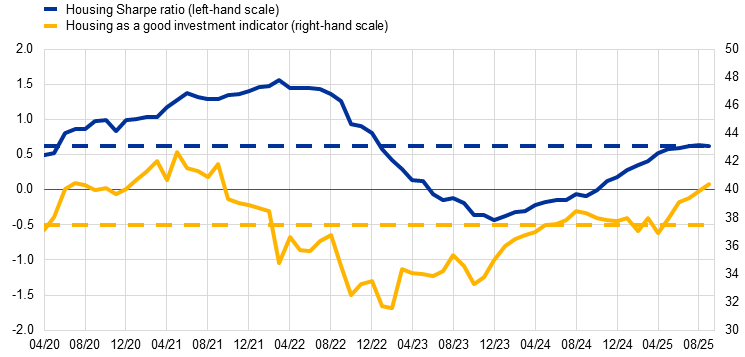
The housing Sharpe ratio has improved markedly over the past year but has remained below its peak of early 2022 (Chart A). Following the COVID-19 pandemic, it rose to a high in early 2022 before falling sharply. A turning point occurred in late 2023, when the ratio began to recover steadily. By September 2025, it had risen slightly above its sample average but remained well below its previous peak. A broadly similar pattern is observed for the “housing as a good investment” indicator (the share of respondents who consider buying a property in their neighbourhood today as a good investment). This started both to decline and to recover somewhat earlier than the housing Sharpe ratio and stood slightly above its sample average in September 2025, though still below its 2021 peak.
Chart A
Housing Sharpe ratio and housing as a good investment indicator
(left-hand scale: mean indicator; right-hand scale: percentage of respondents)
Sources: CES and ECB staff calculations.
Notes: The housing as a good investment indicator measures the share of respondents who consider buying a property in their neighbourhood today to be a “good” or “very good” investment. The blue and yellow dashed lines represent the sample average of the housing Sharpe ratio (0.62) and the housing as a good investment indicator (37.5%) respectively. The latest observations are for September 2025.
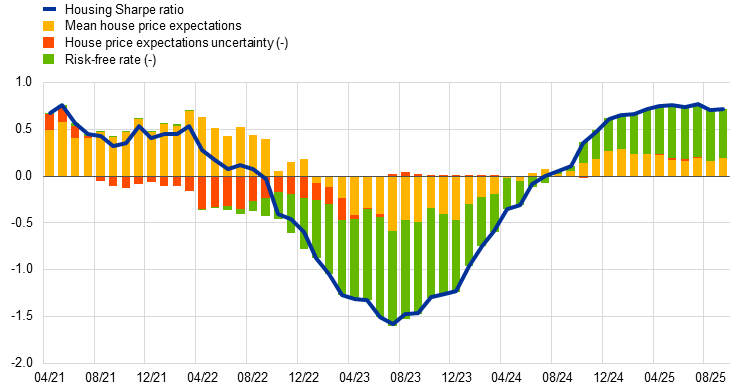
Looking at its components, in recent years the housing Sharpe ratio has mainly reflected fluctuations in house price growth expectations and in the risk-free interest rate (Chart B). Between the end of 2021 and mid-2023, the (year-on-year growth rate of the) housing Sharpe ratio fell strongly. First house price growth uncertainty and later mean house price growth expectations weighed on households’ perceptions of the attractiveness of housing. In addition, the rise in the risk-free rate during the ECB’s monetary policy tightening phase also exerted downward pressure on the housing Sharpe ratio from mid-2022 to late 2023. The increase in the housing Sharpe ratio since July 2023 has been supported by a rise in households’ house price growth expectations, with only a minor contribution from uncertainty.[5] Moreover, it has reflected the drop in the risk-free rate, as monetary policy has normalised again in response to easing inflationary pressures.
Chart B
Decomposition of the housing Sharpe ratio
(year-on-year changes in the mean indicator and contributions of its components)
Sources: CES and ECB staff calculations.
Note: The latest observations are for September 2025.
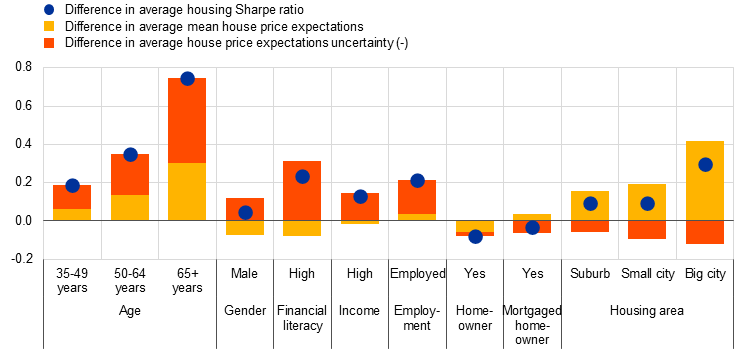
The average housing Sharpe ratio over the period from April 2020 to September 2025 varies markedly across households according to their demographic and economic characteristics, as views on both future house prices and the uncertainty around them differ (Chart C). On average, older, male, wealthier, employed and more financially literate households display higher Sharpe ratios than the respective reference group of households. This is largely owing to lower uncertainty around house price expectations, although differences in mean house price expectations also play a role for some categories. In terms of housing choices, households living in cities or suburban areas report higher ratios than those in rural areas, mainly reflecting higher mean house price growth expectations. Moreover, the housing Sharpe ratio is typically lower for homeowners than for renters, driven by lower mean expectations. Among homeowners however it does not differ significantly between outright owners and those with mortgages.[6]
Chart C
Housing Sharpe ratio by economic and demographic characteristics of households
(difference from base category in average mean indicator and contributions of components)
Sources: CES and ECB staff calculations.
Notes: The reference groups (in order) are defined as follows: 18-34 years old; female; low financial literacy; low income; unemployed; not a homeowner; no mortgage; living in a village. Low income refers to the bottom 50% and high income to the top 20%. Financial literacy is split into two groups: individuals scoring 3 or 4 out of 4 on the CES financial literacy quiz (high literacy) and those scoring lower (low literacy). Homeowner = “no” if respondents are renters or inhabit the dwelling free of charge and “yes” if they reported owning (with or without a mortgage). Mortgaged homeowner = “no” if respondents reported owning their home outright and “yes” if they reported owning with a mortgage. The housing area categories are: (1) a big city with more than 500,000 inhabitants; (2) a suburb or the outskirts of a big city; (3) a city with up to 500,000 inhabitants; (4) a village or rural area. Average Sharpe ratios and contributions of components are calculated over the period from April 2020 to September 2025. The risk-free rate is excluded from these calculations, as it is constant across households.
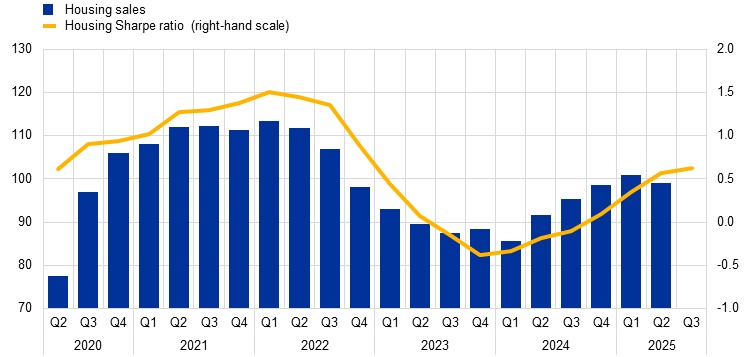
The housing Sharpe ratio points to a further moderate recovery in housing investment. A comparison of developments in the housing Sharpe ratio and actual housing sales shows a close correlation between the two series, suggesting that the housing Sharpe ratio is a relevant indicator for monitoring broader housing market developments (Chart D). Specifically, the increase in the ratio up to September 2025 indicates that housing sales are likely to continue rising, following their slight decline in the second quarter. This, in turn, should support a positive near-term outlook for housing investment and for home goods consumption, which both tend to follow developments in housing sales.[7]
Chart D
Housing sales and housing Sharpe ratio
(left-hand scale: index, 2019 = 100; right-hand scale: quarterly averages of mean indicator)
Sources: Eurostat, CES and ECB staff calculations.
Notes: Housing sales are based on an aggregate of Eurostat data and national data sources for euro area countries. The latest observations for housing sales and the housing Sharpe ratio are for the second quarter of 2025 and September 2025 respectively.
References
Battistini, N., Charalampakis, E., Gareis, J. and Rusinova, D. (2023), “Why has housing lost its lure? Evidence from the ECB’s Consumer Expectations Survey”, Economic Bulletin, Issue 5, ECB.
Battistini, N. and Gareis, J. (2025), “The ripple effects of monetary policy on housing and consumption”, The ECB Blog, ECB, 31 July.
Battistini, N., Le Roux, J., Roma, M. and Vourdas, J. (2018), “The state of the housing market in the euro area”, Economic Bulletin, Issue 7, ECB.
Leamer, E. (2007), “Housing IS the business cycle”, Proceedings – Economic Policy Symposium – Jackson Hole, Federal Reserve Bank of Kansas City, pp. 149-233.
Leamer, E. (2015), “Housing Really Is the Business Cycle: What Survives the Lessons of 2008–09?”, Journal of Money, Credit and Banking, Vol. 47, Issue S1, March/April 2015, pp. 43-50.
Piazzesi, M. and Schneider, M. (2016), “Housing and Macroeconomics”, Handbook of Macroeconomics, Vol. 2, pp. 1547-1640.
Legal Disclaimer:
EIN Presswire provides this news content "as is" without warranty of any kind. We do not accept any responsibility or liability for the accuracy, content, images, videos, licenses, completeness, legality, or reliability of the information contained in this article. If you have any complaints or copyright issues related to this article, kindly contact the author above.
